
























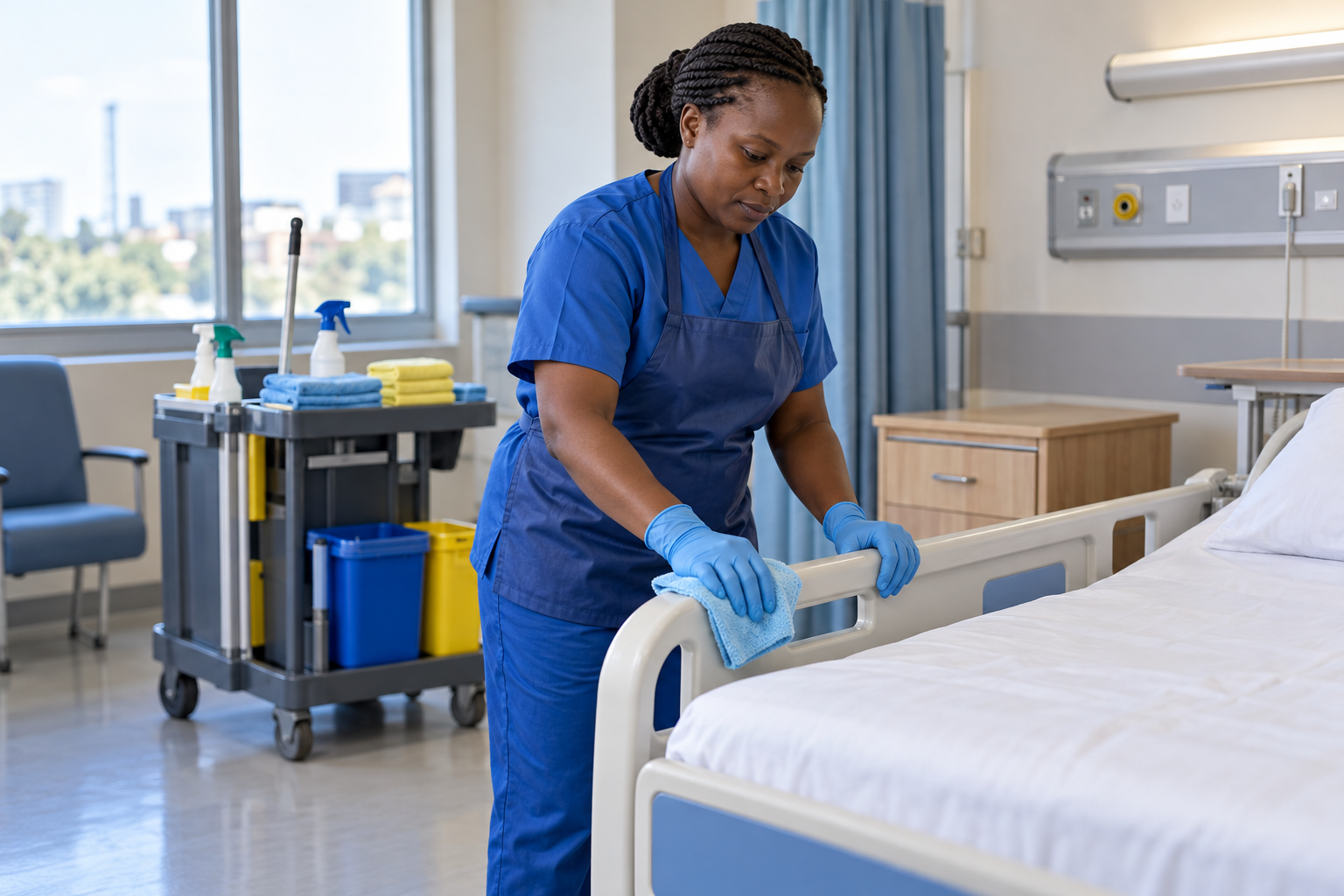
Patients, visitors and clinical staff share surfaces all day. Environmental cleaning helps keep those surfaces visibly clean and supports a hospital’s infection-prevention plan. The cleaning team contributes to that work, but safe practice depends on a clear procedure, suitable products, training and communication with infection-prevention and clinical teams.
A hospital should set its own schedules and methods for each care area. A ward, procedure room, office and public corridor do not have identical risks. This article describes general principles; facility policy, local requirements, product labels and infection-prevention direction take precedence.
Make cleaning part of the safety system
Cleaning staff should be included when a facility decides which surfaces are cleaned, how often and with which products. The people doing the work can point out blocked surfaces, damaged furniture, missing supplies and unrealistic timing. A checklist should describe an observable task, identify the responsible role and show how the completed room is handed back.
Agree on three types of work: routine cleaning during use, discharge or transfer cleaning, and a response to spills or a specific contamination event. The exact frequency and disinfectant depend on the space, surface, amount and type of soil, and clinical direction. Avoid using one schedule for every room.
CDC environmental-services guidance describes a risk-based approach: high-touch surfaces in patient-care areas, such as bed rails, door handles and taps, may need more frequent cleaning than low-touch surfaces such as walls. This is a useful general principle, not a replacement for Kenyan facility policy or local infection-prevention advice.
Prepare tools before entering the room
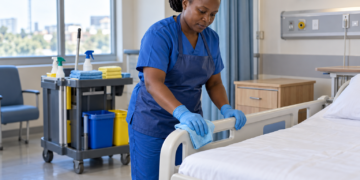
Check the room assignment and any precautions posted by the facility. Gather the required cloths, mop, waste bags, cleaner and disinfectant before starting. Keep products in labelled containers and follow the instructions for dilution, surface compatibility, protective equipment and contact time. Never mix chemicals or refill a product bottle with an unlabelled solution.
Use the facility’s colour-coding or tool-separation system. Keep toilet tools apart from general patient-room tools, and keep clean cloths away from used ones. Change cloths and mop water when the procedure requires it or they become visibly soiled. A contaminated cloth can transfer soil from one surface to the next.
Wear the personal protective equipment required by the room procedure and product label. Remove it and perform hand hygiene according to facility training. Report a tear, spill, missing sign or equipment problem before continuing if it affects safe work.
Follow a consistent room sequence
Move from cleaner areas toward dirtier areas, and from higher surfaces down to lower ones. Clean the bed area, furniture and frequently touched points using the approved order. Wipe each surface with the required method, turning the cloth to a clean side or changing it when needed. Do not shake cloths or use techniques that spread dust into the room.
Clean visible soil before disinfecting unless the product is specifically labelled for a combined step. Apply disinfectant to the surfaces named in the procedure and keep them wet for the full label contact time. A surface that dries too early may need reapplication according to the product directions. Do not spray directly onto a patient, food, open supplies or electrical equipment.
Clean the washroom with its designated tools. Give attention to handwashing sinks, taps, toilet handles and other high-touch surfaces. Keep used items contained so they do not pass through clean areas. If the facility uses a specific order for shared rooms or isolation rooms, follow the assigned procedure rather than improvising.
Respond to spills and unexpected soil
For blood or body-fluid spills, stop and follow the facility’s spill procedure. Keep people away from the area, use the required protective equipment and spill kit, and dispose of waste through the correct route. Do not use a routine cloth or mop until the spill has been handled as instructed. Contact a supervisor when the substance, size or risk is unclear.
For other unexpected soil, identify what it is before choosing a product. A cleaner designed for ordinary dust may not be appropriate for a chemical spill or a material that can damage the surface. Report recurring leaks, odours or damage; repeated wiping will not solve a plumbing or building problem.
Coordinate with clinical staff and patients
Before entering an occupied room, follow the facility’s communication procedure. Explain what you need to do, protect the patient’s belongings and avoid moving medical equipment unless you are trained and authorised. If a device or supply blocks access to a surface, ask clinical staff to make it safe and accessible.
Tell the nurse or supervisor when a room is ready, when work is delayed, or when a defect needs attention. A handover should say what remains unfinished and why. It should not reveal unnecessary patient information. Clear communication protects privacy while helping the next person manage the room.

Train and support the cleaning team
Training should include product labels, dilution, contact time, cloth use, waste handling, hand hygiene, PPE, room sequence and spill response. Demonstrate tasks on real surfaces and allow staff to practise. A signed attendance sheet does not prove a worker can complete a procedure; supervisors should observe the work and provide specific feedback.
Make the procedure available where staff can use it. Ensure trolleys have enough clean cloths, liners and approved products for the shift. If the same steps are repeatedly missed, check whether the task list, staffing level, room access or supply arrangement is the cause before blaming the cleaner.
Check results and improve the process
Use direct observation and room checks to see whether important surfaces were cleaned and whether the process was followed. Record the room or area, time, issue and corrective action. A visual check is useful for visible soil but cannot prove that a surface is free of microorganisms. Use additional monitoring only when the facility’s infection-prevention team approves the method and explains what the result means.
Our earlier guide to measuring cleaning quality with site checks shows how to define visible results. The article on cleaning chemical mistakes covers label and storage errors that teams can prevent. Both are scheduled before this post.
Respect the work and the limits of the role
Environmental-services staff help maintain a clean care environment, but they do not diagnose infections or decide clinical precautions. The facility must give them timely information, training and access to the right tools. Supervisors should encourage staff to report uncertainty without penalty.
Reliable hospital cleaning comes from a consistent sequence, appropriate products and a team that can communicate with clinical staff. Match the method to the room, clean the surfaces named in the procedure, follow the label and report anything that stops the work from being completed safely.
Source note: CDC environmental-services guidance is used for general risk-based cleaning principles. It reflects U.S. guidance; local Kenyan facility policies and requirements govern the work.
CDC: Environmental Services · CDC: Environmental Cleaning Recommendations